

Contact Details

Fuel costs have been rising steadily across the globe, driven by ongoing geopolitical tensions and supply disruptions. New Zealand is no exception, with fuel prices reaching as high as $3.49 per litre for unleaded 91 as of April 10, 2026.
This sharp increase is affecting everyone, including daily commuters, frequent travellers, and small and large businesses that rely heavily on transportation.
As a result, more Kiwis are now paying more attention to fuel economy when choosing a vehicle. In today’s environment, selecting the best fuel-efficient car is no longer just a preference; it’s a wise financial decision.
In this guide, I’ll explore the most fuel-efficient cars and help you make a better choice during the current fuel crisis.
Rising petrol and diesel costs are having a direct impact on the cost of living across New Zealand.
For example, in December 2025, regular 91 petrol averaged around $2.66/litre, while premium 95 was about $2.84/litre. By April 2026, the price of 91 has surged to approximately $3.49 per litre, an increase of $0.83 in just four months.
If current global conditions continue, fuel prices could climb even higher, potentially reaching $4 per litre or more. This makes fuel efficiency more important than ever for everyday drivers.
Choosing a fuel-efficient car is one of the most practical ways to manage rising fuel costs and reduce long-term expenses. In addition, fuel-efficient vehicles produce lower carbon emissions, helping reduce environmental impact and support a more sustainable future.
A car’s fuel efficiency depends on factors such as engine size, technology, weight, and aerodynamics.
For instance, a smooth and aerodynamic body shape allows the car to move with less effort. This is why sedans are generally more fuel-efficient than SUVs; lighter vehicles require less energy to move. Additionally, smaller engines and hybrid systems help to reduce fuel consumption.
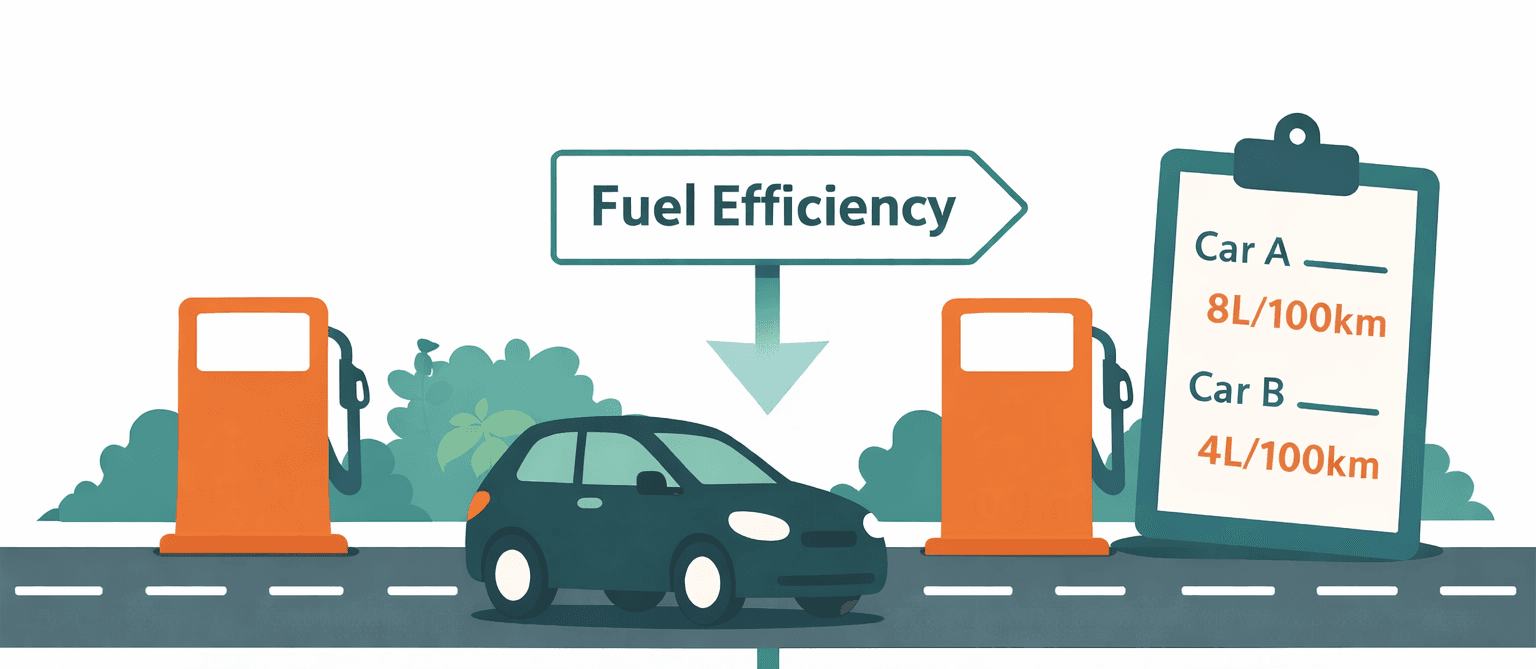
Driving habits also play a crucial role in fuel efficiency. The metric L/100 km is commonly used to measure fuel consumption. For example, if the car consumes 3 L/100 km, it means that it uses 3 litres of fuel to travel 100 kilometres, which is typically considered very fuel-efficient when compared to a car that consumes 4 L/100 km or more.
Here are the most fuel-efficient cars, including hybrid, petrol, and electric options, as of 2026.
Here are the top-ranked self-charging hybrid vehicles.
| Rank | Make/Model | Fuel Economy | Type | Best For |
|---|---|---|---|---|
| 1 | Toyota Aqua | ~3.0 – 3.6 L/100km | Hatchback | Daily commuters |
| 2 | Honda Jazz/Fit | ~3.3 – 4.5 L/100km | Hatchback | City commuters, small families, practical drivers |
| 3 | Toyota Yaris | ~3.3 – 3.8 L/100km | Hatchback | Modern technology lovers |
Here are the top-ranked petrol-saving vehicles in New Zealand.
| Rank | Make/Model | Fuel Economy | Type | Best For |
|---|---|---|---|---|
| 1 | Suzuki Swift | ~4.0 – 4.3 L/100km | Hatchback | Small families |
| 2 | Toyota Yaris | ~3.0 – 3.3 L/100km | Hatchback | Modern technology lovers & city driving |
| 3 | Mazda Demio | ~4.1 – 6.5 L/100km (depends on engine) | Hatchback | Budget-conscious buyers & urban commuting |
Here are the top-ranked electric vehicles. However, it’s important to note that they have zero fuel cost, but these are charging considerations.
| Rank | Make/Model | Energy Consumption (kWh/100km) | Type | Type | Best For |
|---|---|---|---|---|---|
| 1 | Tesla Model 3 | ~13.6 – 16.5 kWh/100km | ~13.6 – 16.5 kWh/100km | Sedan | High-tech performance |
| 2 | BYD Dolphin | ~15.9 kWh/100km | ~15.9 kWh/100km | Hatchback | Affordability & city driving |
| 3 | Nissan Leaf | ~17 – 19 kWh/100km | ~17 – 19 kWh/100km | Hatchback | Comfort & reliability |
Choosing between hybrid, petrol, and electric vehicles depends on your budget and driving needs.
Hybrid cars offer a balance, combining fuel efficiency with lower running costs, making them perfect for city driving. Petrol cars generally come with a more affordable buying cost, but they can become expensive over time due to higher fuel consumption.
On the other hand, electric vehicles (EVs) stop fuel costs entirely and are the most eco-friendly option, though they often come with a higher purchase price and require access to charging infrastructure. During the current fuel crisis, hybrids and EVs are becoming increasingly popular choices for long-term savings.
By following these simple tips, you can improve fuel efficiency.
About the Author
Manpreet Kaur
Office AssistantManpreet works as an Office Assistant. She began her professional journey with [wps_business_name], where she has developed a solid understanding of the automotive and customer service sectors. With...
